Introduction and overview of STP and RSTP
STP (Spanning Tree Protocol) is a layer two protocol. It allows you to add backup links to the network. Backup links protect the network from going down if the primary links fail. However, they also create switching loops. Switching loops causes broadcast storms and destabilizes the CAM table. These issues block the network from functioning properly. STP addresses these issues. It logically blocks links that create loops and monitors the network for changes. If a primary link goes down, the backup link is enabled. Since it maintains only one link per destination, no switching loop occurs in the network.
There are many variations of STP. Digital Equipment Corporation (DEC) created the original version of STP for its switches. Later, IEEE developed an open-standard version of STP. Neither version is compatible with the other. You can use only one in a network. If you run both in the same network, the network will face switching loops.
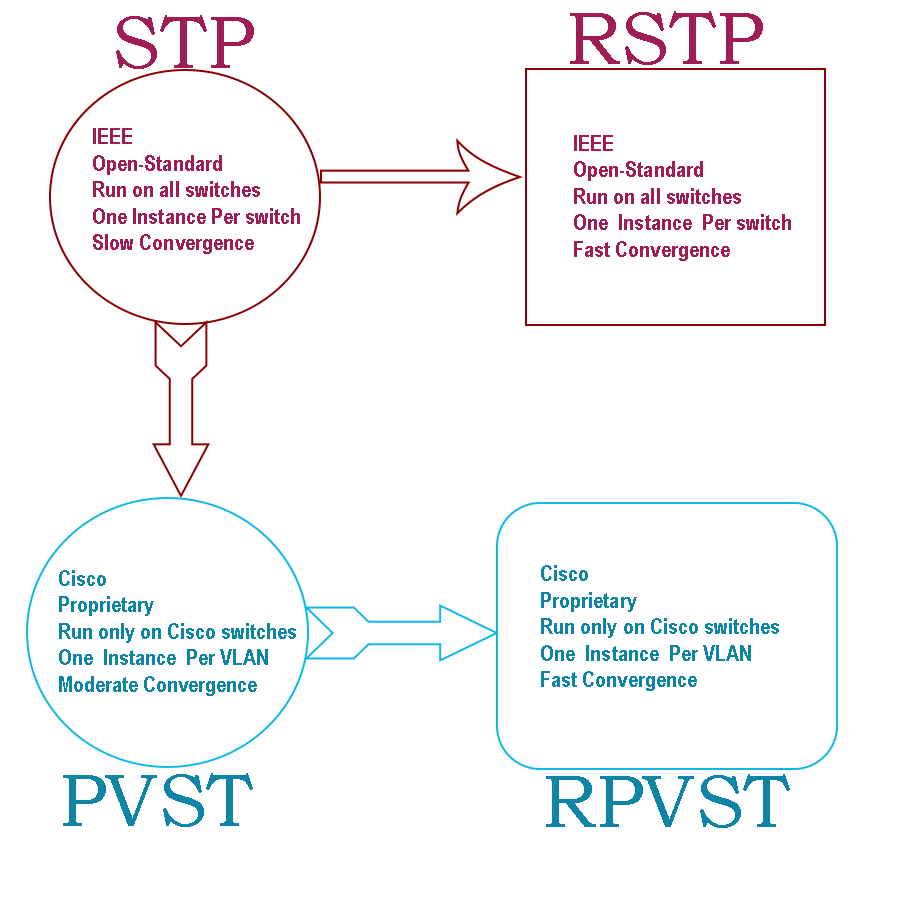
Cisco uses its own variation. Cisco's STP is called PVST (Per VLAN Spanning-Tree). The main difference between STP and PVST is that STP runs only one instance per switch, whereas PVST runs a separate instance for each VLAN. For example, if a switch has five VLANs, STP runs only one instance, whereas PVST runs five. In addition, PVST also includes some add-on features, such as PortFast and EtherChannel. PVST is a Cisco proprietary protocol. It works only on Cisco switches. It is enabled by default on Cisco switches.

Since PVST uses the same framework and terminology STP uses, it's common to use the term STP for PVST. If you ever get confused about which variation the switch is running, you can check the manufacturer's information on the switch. If it is a Cisco switch, it will be PVST. If it is a non-Cisco switch, it will be STP.
IEEE first standardized STP as part of IEEE 802.1D in 1990. At that time, convergence was not a matter of concern. Convergence is the time STP takes to respond to a network change. For example, if a link goes down, convergence is the time STP takes to enable the backup link. STP takes fifty seconds to select and enable the backup links. Most modern networks cannot afford a fifty-second delay on every network change. If a network link flaps, this delay can bring the entire network down.
IEEE updated its STP to reduce convergence time and meet modern network requirements, resulting in RSTP (Rapid Spanning Tree Protocol). RSTP is the default in most networks. Cisco also updated its PVST to RPVST. RSTP/RPVST are built on the STP/PVST framework.
This tutorial is part of the tutorial series "STP, RSTP, PVST, RPVST, and MSTP Explained with Examples". Other parts of this series are the following.
Chapter 01 Introduction and overview of STP and RSTP
Chapter 02 STP, RSTP, PVST, RPVST, and MSTP
Chapter 03 Similarities and Differences between STP and RSTP
Chapter 04 STP and RSTP Terminology
Chapter 05 STP/RSTP Timers Explained
Chapter 06 The Bridge ID and System ID Extension Explained
Chapter 07 PVST/STP Root Bridge Election Process Explained
Chapter 08 STP Port and Path Costs Explained
Chapter 09 STP Port States:- Blocking, Listing, Learning, and Forwarding
Chapter 10 STP - Spanning Tree Protocol Explained With Examples
Chapter 11 RSTP Port States and Types Explained
Chapter 12 PVST/RPVST and EtherChannel Explained
Chapter 13 RSTP / RPVST Explained with Examples
Conclusion
STP (PVST) and RSTP (RPVST) are spanning-tree protocols that eliminate network loops. STP (PVST) is older and slower to converge than RSTP (RPVST). RSTP (RPVST) replaces STP (PVST) in modern networks. RPVST is the default on all Cisco switches.
Author Laxmi Goswami Updated on 2026-05-12