WAN Tutorial – Basic WAN Switching Concept Explained
This tutorial introduces foundational concepts in WAN networking. It explains switching methods (circuit switching, cell switching, and packet switching) and describes WAN terms such as CPE (devices at customer sites), demarcation point (point where provider and customer meet), local loop (connection between user and provider), CO (provider's office), toll network (provider's large-scale network), CSU (device synchronizing digital signals), DSU (data conversion unit), DTE (equipment like computers generating data), DCE (equipment like modems providing connection timing), and WAN protocols include HDLC, PPP (used for establishing direct connections), ISDN, Frame Relay, MPLS, ATM, DSL, and Cable.
Difference between LAN and WAN
A Wide Area Network (WAN) connects multiple network segments across geographically distant locations using specialized technologies and hardware. A Local Area Network (LAN) is a network that covers a limited geographic area, such as a home, campus, café, or office building.
A WAN spans multiple geographic locations and interconnects several LANs, thereby forming a single, extensive network. For example, if a company has a LAN in its Ohio office and another in its Los Angeles office, connecting these networks to enable data sharing constitutes a WAN.
Another key distinction is control and ownership. LANs are usually owned and managed by organizations, allowing the direct installation of networking devices, unlike WANs, which require leased connections across external networks. Organizations must lease or rent connections from cable providers. To illustrate, consider the analogy of traveling from Ohio to Los Angeles. Rather than constructing a personal road, you utilize existing infrastructure. You use government-built roads and pay a toll. Similarly, cable network companies build networks that you access for a fee. Several providers, including ISPs, offer these services. In short, WANs connect LANs through such companies.
WAN Terminology
WAN is vast. It includes several services and technologies from different vendors. These services and technologies use various terms to define their features and functions. The following section describes essential terms and their meanings.
CPE
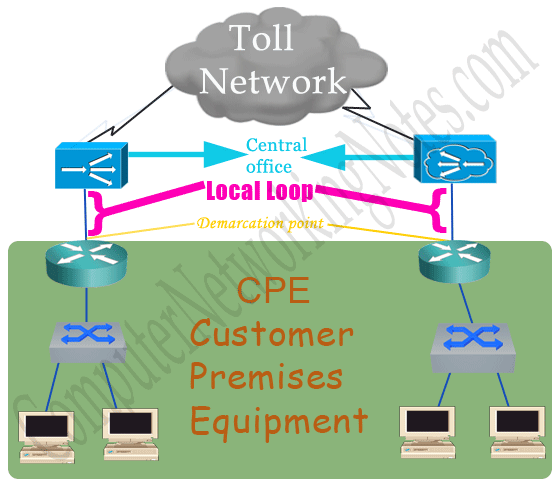
CPE (Customer Premises Equipment) defines the devices located at the subscriber's location, such as modems (which allow data transfer over telephone or cable lines), switches (which connect multiple devices on a network), CSU/DSU (devices that help connect local networks to WANs and convert digital data), DTE routers (routers responsible for sending and receiving information), and NT1s (devices that help connect to ISDN lines).
Demarcation point
A Demarcation Point (DP) is the point at which the customer's and the cable network provider's responsibilities are separated. Usually, this is a piece of equipment, such as a box or panel, installed by the telecommunications company. In simpler terms, it is the point where the customer's wires or cables connect to the service provider's wires or cables.
Local Loop
The local loop is the actual wire or connection that runs from the demarcation point to the network provider’s facility, called the Central Office (the closest point of connection to the wider network).
Central office
The central office is the nearest facility owned by your service provider that connects your network to their wider system. It's where your local network joins the broader provider’s network.
Toll network
The toll network is the telecommunications company's internal system, consisting of cables and devices, used to transport data over long distances. Telecom companies install extensive cabling and devices between demarcation points and offer multiple WAN connection types based on customer needs.
CSU/DSU
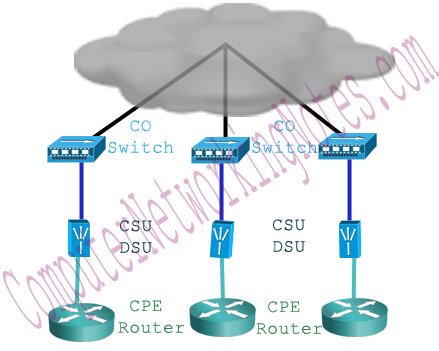
A Channel Service Unit/Data Service Unit (CSU/DSU) is a device that converts digital data signals between a LAN and a WAN. Because LANs and WANs use different communication protocols, a CSU/DSU enables interoperability between them. Devices such as DSL modems (for internet over telephone lines) and cable modems are examples of CSU/DSUs.
DTE
Data Terminal Equipment (DTE), such as routers or computers, generates and receives data frames and communicates with DCE to transmit data over the WAN.
DCE
DCE (Data Circuit-Terminating Equipment), such as modems or CSU/DSUs, provides timing and synchronization for data over the WAN.
WAN connections
There are four main types of WAN connections: Leased Line Connection (dedicated path), Circuit Switched Connection (temporarily created path when needed), Packet Switched Connection (shared path that splits data into packets), and Cell Switched Connection.
Leased Line Connection
A leased line provides a dedicated connection between LANs, offering constant availability, guaranteed bandwidth, and low latency. However, it includes high cost, limited range, charges regardless of usage, and the requirement for a separate router interface for each line.
- It is available for shorter distances.
- It is the most expensive WAN solution.
- It is charged for the entire time, whether you use it or not.
- Each line requires a separate interface on your router.
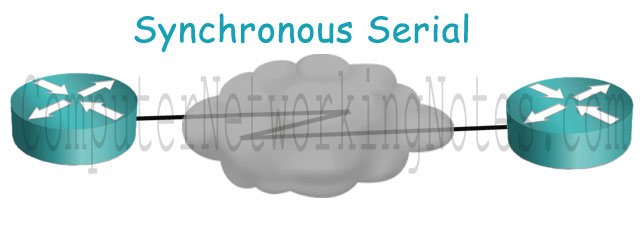
A leased line, also called a point-to-point or dedicated connection, gives a direct link between two networks. It uses protocols such as HDLC (a reliable data transfer protocol) and PPP (a protocol for connecting two network points) to ensure data is sent accurately over the line.
Circuit Switched Connection
A circuit-switched connection establishes a dedicated path for each data transmission and incurs charges only during active use. Each session requires a new connection to be set up. There are two types of circuit-switched connections: asynchronous and synchronous.
Asynchronous serial connection
An asynchronous serial connection uses an analog modem and a standard telephone system to set up a dial-up connection. This is the least expensive WAN service, but also the least reliable and slowest. In the USA, these connections can reach up to 53 Kbps (kilobits per second).
Synchronous serial connection
A synchronous serial connection uses a digital ISDN (Integrated Services Digital Network) line, which may include a BRI (Basic Rate Interface, providing two 64 Kbps channels) or a PRI (Primary Rate Interface, offering additional channels), for dial-up connectivity. This service is more costly but provides guaranteed bandwidth.
Circuit Switched connection
Circuit-switched connections are usually backup solutions or temporary home connections. They’re billed per minute and aren’t suited for large data transfers due to high time and costs.
Packet Switched Connection
A packet-switched connection offers a cost-effective alternative to leased lines by sharing bandwidth among users and employing a billing model similar to that of circuit-switched connections. It differs from a leased line connection in terms of bandwidth. In it, full bandwidth is available only when no one else is transmitting. It is best for bursty, not continuous data.
Both leased line and circuit-switched connections use a physical circuit path to connect two sites. While a leased line uses the same circuit path every time, a circuit-switched connection builds a path for each data call. You may get the same path or a new one for every data call in a circuit-switched network.
Packet-switched connections use logical routes (virtual circuits) rather than specific cables over existing links. Multiple virtual circuits can use one router interface to reach several sites.
Cell Switched Connection
Cell-switched connections represent an advanced form of packet-switched technology, offering guaranteed bandwidth, low latency, low error rates, and Quality of Service (QoS) to ensure reliable delivery. Data is transmitted in fixed-size blocks of 53 bytes, known as cells.
WAN connections
Based on data transmission technology, WAN connections can be divided into two types: asynchronous and synchronous.
Asynchronous connection
An asynchronous connection sends data without prior coordination. The receiver extracts decoding and sync info from the data.
Synchronous connection
Synchronous connections coordinate the sender and receiver before data transfer. The sender supplies transmission settings with each data packet; the receiver updates its state based on what it receives.
WAN Protocols
WAN uses various protocols to provide connectivity and transfer data between remote sites. The following section describes the features and functions of the most widely used WAN protocols.
HDLC
HDLC operates at the Data Link layer and adds little overhead. It lacks network-layer information in its header. Each vendor must add its own protocol identification mechanism, which might not be compatible with those of other vendors. Thus, all devices must be from a single vendor.
PPP
The Point-to-Point Protocol (PPP) is a widely used data-link layer protocol that includes a field for network layer protocol information in its header. As a result, vendors do not need to modify the protocol, and it can be used as specified. PPP is particularly suitable for establishing point-to-point links between equipment from different vendors.
PPPoE
Point-to-Point Protocol over Ethernet (PPPoE) adapts the PPP protocol for use over Ethernet networks. When deployed with Asymmetric Digital Subscriber Line (ADSL) services, it enables direct Ethernet connectivity while supporting DSL. PPPoE offers features such as authentication, encryption, and compression, but it has a lower maximum transmission unit (MTU) compared to standard Ethernet.
ISDN
Integrated Services Digital Network (ISDN) employs circuit-switched connection technology and utilizes existing telephone lines for both voice and data transmission. ISDN is commonly used as a secondary backup connection and offers a cost-effective upgrade for users requiring higher speeds than those provided by analog modems.
LAPD
The LAPD (Link Access Procedure, D-Channel) protocol was developed for ISDN. It is used to satisfy the signaling requirement of an ISDN connection.
LAPB
LAPB (Link Access Procedure, Balanced) was created for X.25 as a connection-oriented protocol at the Data Link Layer. It can also be used for simple data link transportation. Due to its windowing and strict time-out mechanisms, it creates significant overhead.
Frame Relay
Frame Relay utilizes packet-switched connection technology and can provide bandwidth ranging from 64 Kbps to 45 Mbps. It establishes logical circuits over physical circuits to transmit data, enabling multiple remote sites to be connected through a single interface. Frame Relay also provides dynamic bandwidth allocation and congestion control.
MPLS
Multi-Protocol Label Switching (MPLS) is a data-forwarding technology based on frame relay principles. Similar to frame relay, MPLS incorporates certain circuit-switched features within a packet-switched environment. It forwards packets using labels assigned at the network edge, allowing core routers to expedite packet forwarding. As a result, many organizations are transitioning from Frame Relay to Asynchronous Transfer Mode (ATM), an advanced version of Frame Relay that supports the simultaneous transmission of video, voice, and data. ATM uses fixed-length 53-byte cells for data forwarding and supports external clocking to enhance transmission speed. ports external clocking.
DSL
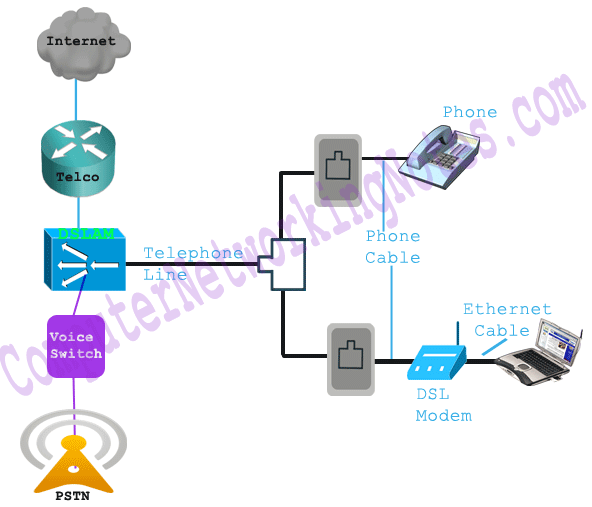
In a DSL (Digital Subscriber Line) service, a connection is established between the CPE (usually a modem) and the DSLAM (Digital Subscriber Line Access Multiplexer). DSLAM is a device that concentrates connections from multiple DSL lines. It is located at the CO (Center Office of Telco). It uses twisted pair copper telephone wires for connectivity. It is the same phone line used to connect your phone to the CO. On the CPE side, it uses a DSL modem that complies with the DSL physical and data link layer standards to transmit data from the Telco. The following figure illustrates that a DSL service offers asymmetric speeds, with download speeds significantly higher than upload speeds. Download speed is much faster than the upload speed.
Cable
Cable Internet service utilizes the existing cable television network infrastructure. It can provide download speeds of up to 27 Mbps and upload speeds of up to 2.5 Mbps. Users share bandwidth within a given cable network segment, resulting in actual user bandwidth ranging from 256 Kbps to 6 Mbps.
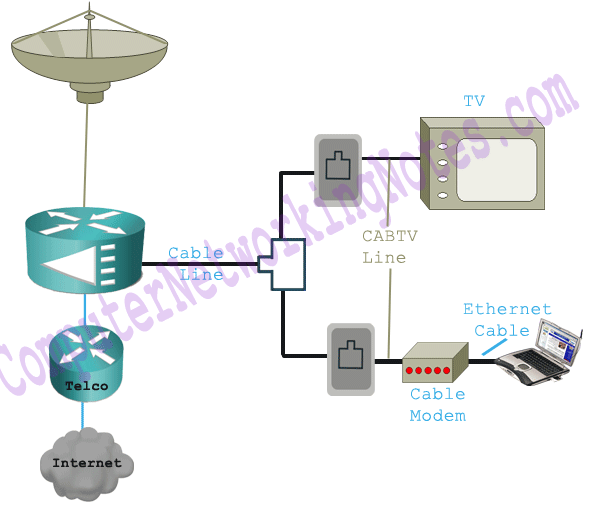
Key points of DSL and Cable services
- Both services use the existing network. DSL uses a phone line, while Cable uses CATV (Cable TV) cable.
- Both services offer asymmetric speeds, with download speeds much faster than upload speeds.
- Both services operate in an always-on mode, allowing the user to access the Internet without taking any action to start the connection.
- Both services are used to connect CPEs to COs.
- DSL service uses twisted-pair cable, while Cable service uses coaxial cable.
- On the customer side, DSL service uses a DSL modem, while Cable service uses a cable modem.
- On the company side, DSL uses a DSLAM to filter voice and data, while Cable service uses a router to split data and video traffic.
Serial WAN Encapsulation method and protocol
Not all of the previously discussed protocols and methods are available for serial interfaces. The available options for a serial interface can be displayed using the encapsulation command in serial interface mode. For example, the following figure illustrates the encapsulation options for a router's serial interface.
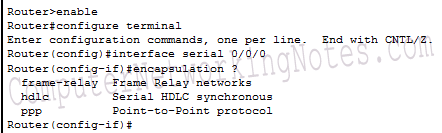
The available encapsulation options may vary by router model. On actual Cisco routers, additional options such as ATM-DXI, LAPB, SMDS, and X.25 may be present. The output shown here is from a virtual router operating within the Packet Tracer network simulator. As output shows, it has three encapsulation methods:-
- HDLC
- PPP
- Frame-Relay
This tutorial is part of the tutorial series "WAN Terminology Explained with Encapsulation Protocols and Methods". Other parts of this series are the following.
Chapter 1 WAN Tutorial – Basic WAN Switching Concept Explained
Chapter 2 HDLC Protocol and Encapsulation Method Explained
Chapter 3 PPP Protocol and Encapsulation Method Explained
Chapter 4 Basic Concepts of Frame Relay Explained in Easy Language
Chapter 5 How to configure Frame Relay: Step-by-Step Guide
Conclusion
Understanding WAN fundamentals is essential for designing, managing, and troubleshooting modern networks spanning cities or even continents. WANs connect multiple LANs using specialized technologies, enabling organizations to communicate, share resources, and access information globally. The choice of connection type (leased line, circuit-switched, packet-switched, or cell-switched) depends on requirements for speed, reliability, and cost. Familiarity with core concepts such as CPE, demarcation point, local loop, and various protocols (HDLC, PPP, ISDN, Frame Relay, MPLS, ATM, DSL, and Cable) allows you to make informed decisions and maintain efficient, secure data transfer.
Author Laxmi Goswami Updated on 2026-03-09